

This is an article originally written in 2015, re-paginated in 2024 on the occasion of the website redesign.
I have always considered the NXR to be the most sophisticated desert prototype ever built.
If compared with the other big names of the time I think it had exorbitant production costs.
The engine, for example, was built exclusively for her. There was no counterpart on the production versions or even in racing.
The Supertenerè or XTZ 840 was equipped with an almost standard engine, that of the TDM, the Cagiva was equipped with a Ducati pump and the BMW one of its Boxers. However elaborate or advanced as it might be, it is not the same as designing, building and developing an engine from scratch in an era in which the drawing board was the main design tool, and CAD was still science fiction.
And then, even studying it in detail it is clear that the weight distributions were not that different compared to the motorcycles of ten, fifteen years later.

It was ahead of its time, but above it all it was one of those bikes that when I looked at them in photos, made my heart beat. And I’m thinking not just me, given the quantity of Rothmans Replicas I’ve seen around.
But if I have to tell the truth, even though I have seen excellent bikes, none of them resembled the NXR in the slightest, except in the colours.
I had my poor Africa Twin at home, so one day I decided! I’ll try! It could be done, the tanks were low and fat, there was no chassis behind but a short load-bearing tank that ended halfway up the wheel.
I gathered courage and threw myself into it. Once I had studied as much as possible I uploaded the photos to Autocad, superimposing them on the frame drawing of my XRV 750 to check its feasibility and to my joy I understood that it could really be done.
I then traced a whole series of lines from which I could obtain dimensions relating to the real motorbike.
The “face” of the NXR
Spending some time observing, I realized that my favorite, the ’89 NXR, had a face that was practically identical to the second Africa Twin, the rd04, the 1990 750.
I then found a fairing from the 04 and set to work to make the headlight holes smaller, because the real queen had small eyes. The similarity of the domes was impressive, it even had the exact same air intakes.
I succeeded in the task of making the holes in the dome smaller using what I had in the company, i.e. protective flanges for gutter supports.
I completely redid the front instrument holder frame to house the new headlights and for reasons of space and practicality I also housed the radiator fluid tray.
Purely rationally, I also placed the voltage regulator under the light, the cooldest place on the bike.
The face of the 04 is really similar to that of the latest NXR

I also tried to modify the face of the 07 but nothing was right.

NXR Replica. Voltage regulator in a cold place.
NXR Replica. Regolatore di tensione al fresco.
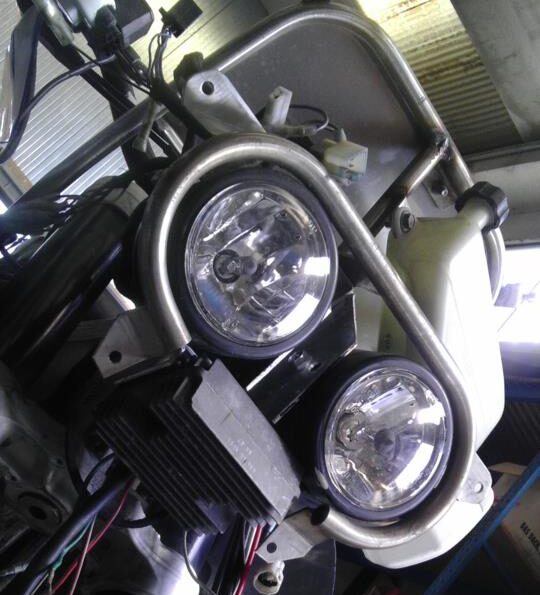
The front when the bike is finished. Really similar to the original.

The rear tank for my Africa Twin
Once the windshield was in place, I started from behind. I hadn’t yet decided what to do with the front tank because I had several at home, I was in doubt whether to recover a Boano or build it from scratch. When in doubt, he started from a certainty: The rear tank had to be done.
Since I wanted to exaggerate and that these jobs represent constant challenges for me, I started by cutting away the seat support frame.
The NXR had a carrier tank and mine would have had it too.
Without the tanks the bike looked like the image on the right.
Without the tanks the bike looked like the image below.

I built a housing for large vibration dampers that came from the steering system of a Defender and positioned them in such a way as to create favorable leverage, therefore with the low supports much closer to the rear wheel than the high ones.
This was an advice from my friend Giordanengo, which I can only thank. Among other things, the layout was the same on the original bike too.
Then I started making the load-bearing rear tank. I started by doing a test and using some rather large aluminum plates so as not to take any risks. Shaping the 3mm is not very easy but it allows you to file away material if you have not done very precise work.
The rear was good almost immediately, let’s say acceptable.
Left side under construction
Then I modified the bindings according to the advice of a friend and took the upper binding much further forward.

Right side
Right side still in progress.

Tail
As a tail I mounted an Aprilia Rally 125

The front tank of the NXR Replica
At this point all the tanks I had were no good, I had to make do. But these are the challenges I like and so I took on them.
I then created the giant front tank.
The NXR had a very low fuel tank. The top was also low compared to any Africa Twin, and the bottom reached really low, in an effort to lower the center of gravity.
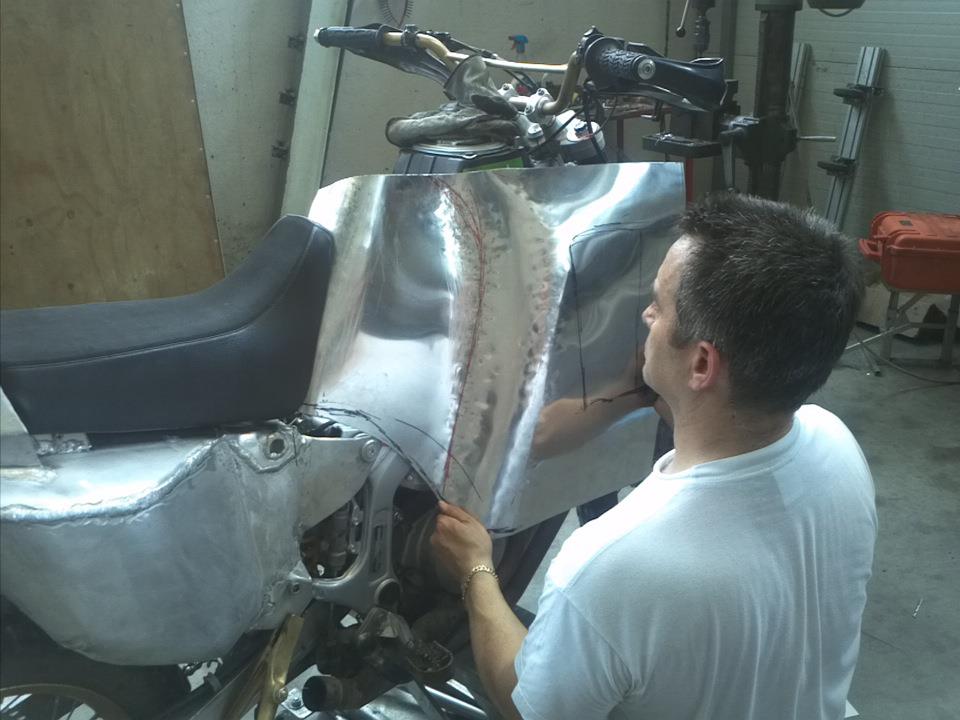
Here is a gallery with some photos of the work in progress:
Tank pulled smoothly with the English wheel, a tool I fell in love with.
Lisciato un poco con la ruota inglese.

Here you can see the inner shell and the outer part of the tank. In the standard Africa Twin the tank reaches almost the same level as the radiators.

What a work! Here are my creations.

Sketch a skid plate with water trays for the driver, mandatory in African races.

Unlike the 07 Standard, in my NXR Replica I built the tank to have it squeezed between my legs.

I post these photos to point out how low and centralized the masses are in this prototype.

The bike ends halfway back on the rear wheel, with only the mudguard remaining exposed behind it. As a result of the absence of cantilevered weights, the bike was much more stable and less likely to lose its rear end when cornering.

Then, the drama.
The saga of the front side panels
The front side panels were missing and I was disappointed when I realized that the ones on the 04 really didn’t fit.
The 04 sides, looked very bad.

The spectacular 07 kevlar side, too bad it looked like shit on the bike.

I went into a crisis, I always have a moment of crisis when I build a motorbike.
It’s the critical point.
The point where I’m tempted to throw everything in the scrap bin and start from the beginning.
Once I threw an entire motorbike into the bin.
It’s where I have to force myself to move forward.
But now I know myself, it’s a bit like the end of the climb, then the descent begins.
The truth is that I was afraid of not being able to make the side panels in aluminium. I had never done any. I took some scrap aluminum foil to test.
They were passable on the first try.
PHOTO: First attempt at the front side panel, all made of English wheel. Succeeded.

The NXR Dakar Replica finished in my opinion
Luckily for me I have wise and “pain in the ass” friends.
Sometimes they become less wise and too much of a pain in the ass, so I don’t call them anymore and stay alone here in my cave for months.
But sometimes they have reasonable advice to give me.
I finished the bike, in the next 3 photos here is how the bike was finished for me:

Enough, this is where the bike is finished to me. I love raw metal.

In this photo you can see how low the tanks are, the filter box of the 07 completely comes out of the tank line. As a result of such an altered center of gravity, the bike was very rideable.

Capacity of 60 liters of petrol, almost 1200 km without refueling.
The colors and stickers
The painting and stickers was another noteworthy work.
My friend Damiano Caracciolo helped me paint the beast.
The differences with a standard Africa Twin are very evident.


My friend Manuel Forni, from the Decalmoto company, passionate about old Dakarian glories, came here for hours to reproduce the stickers of the time and I can only thank him for his passion.
Emanuele working on the decals

A thank you to the friends who helped me finish this project

Her first trip

FINALLY FINISHED!

Image gallery, click on one to enlarge.


In the end this raw motorbike looked very fine!
How did it ride?
This bike ran wonderfully.
The very low center of gravity made the weight of the petrol almost irrelevant, the bike weighed about twenty kg less than the original, but above all it had completely different weights.
When cornering on fast off-road tracks it no longer skidded. I think it was due to the fact that the bike was extremely lighter at the rear. By not having the frame under the saddle and finishing the entire bike halfway through the wheel, the bike was really more stable. But the most surprising thing was the handling. Truly remarkable.
A few years later I saw the original NXR in person, which was paired with the new CRF 1000, I was amazed. Mine, although crude, wasn’t as crude as the original, which really only cared about functionality.
Here you will find a video of Fabio Motopatitori returning after a test ride.
It was 6 months of night sweats, because I have two jobs and a large family, so all the work was done on weekends and stealing time here and there.
But it was a great professional growth and a period of intense satisfaction.
In the end the bike ran great and was gorgeous.
I managed to stay dry despite the 60 liters of petrol, but that’s another story.